

Historical forests of Glen Lochay: Tree pollen analysis
Authors: Stuart Smith, Annabel Everard and Althea Davies
There are questions around when Glen Lochay last had forest, or even whether it was ever forested. In living human memory Glen Lochay has been grassland valued for livestock grazing. To examine this, we have carried out a tree pollen analysis from peat samples, collected in the Glen in the Spring 2024.
Based on the analysis, there is clear evidence of the Glen being forested over long periods during the past three millennia, with our analysis dating back to approx. 900 BC
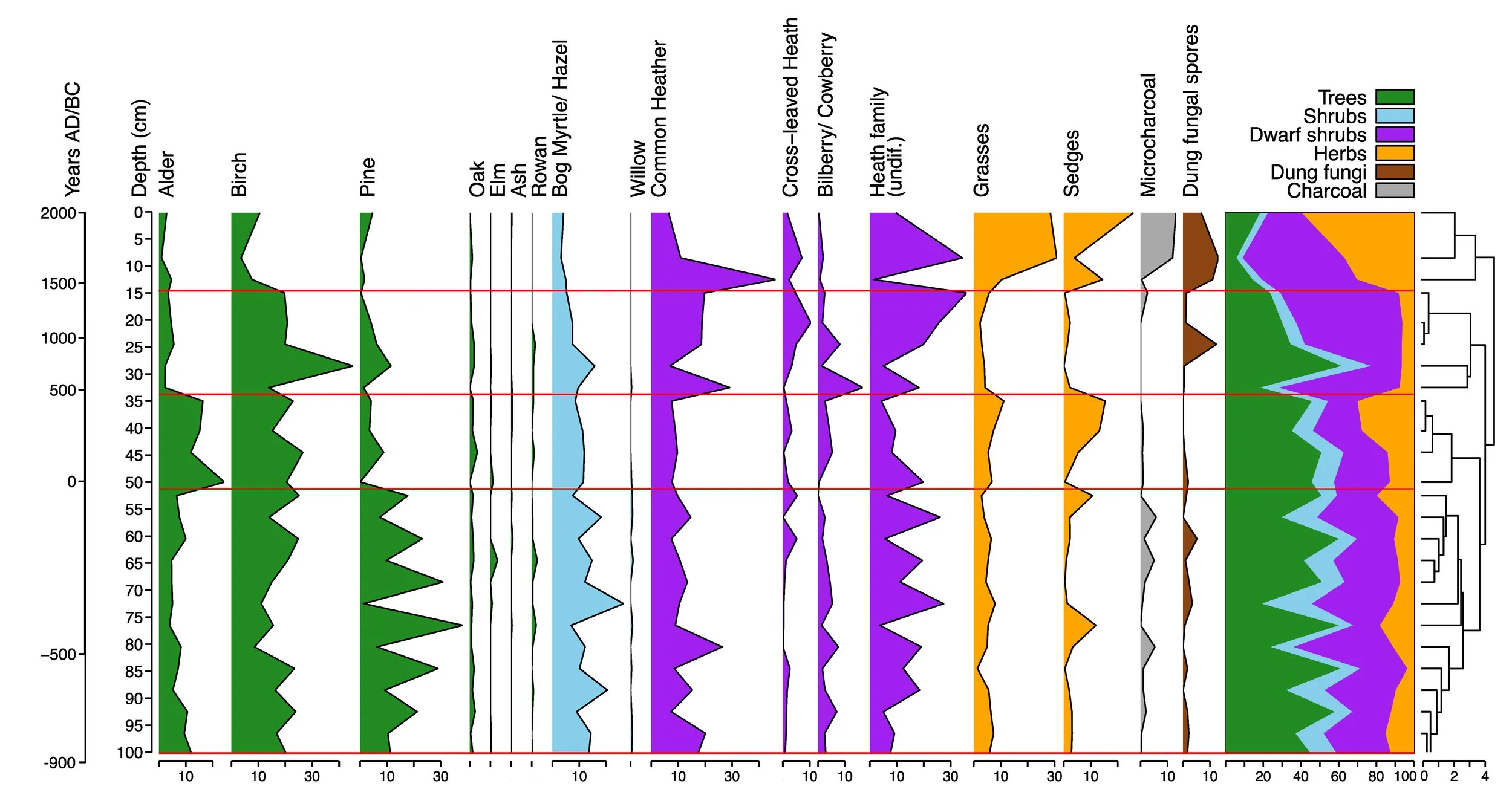
A diagram of relative abundance of terrestrial pollen, charcoal, and fungal dung spores through time. On the left side, depth of peat samples analysed and estimated date of peat based on 14C radiocarbon dating. Constrained cluster analyses (CONISS) has been used to define key changes in vegetation habitats, considering only the terrestrial pollen.
In the earliest period in the Glen Lochay pollen record, from 4 BC to 862 BC (see the bottom red line at 100 cm depth in peat profile on the diagram), the Glen forest was dominated by pine trees, likely Pinus sylvestris. The dominance of pine forests in Glen Lochay over this period is a bit of mystery for the area. Other pollen records around Loch Tay, which go back to 1000 BC, have shown that pine pollen contributed less than <1% of tree pollen, whilst at Glen Lochay pine appears to be dominant. Generally, pine disappeared with a wetter climate over this period.
In our pollen diagram the relative increase and decrease of pine pollen through time is unusual and would suggest disturbance of the peat profile, but this was not apparent with the radiocarbon dating of peat. It remains a mystery where, how recently and in what abundance pine trees survived and this would benefit from more tree pollen research in the Glen and the wider region.
Between 4 BC to 392 AD (red line at 50 cm depth in peat profile) Glen Lochay was dominated by alder (Alnus glutinosa) forest. The upper Glen is rich in archaeology over the same period with neolithic rock art, Bronze age hut circles and Iron Age roundhouses [1]. It has also been suggested that the river name Lochay (derived from Lòchaidh) connects linguistically to the Latin phrase nigra dea, meaning "the black goddess" or "dark goddess," and several goddesses were associated with alder in pictish culture and religion [2]. For example, one of the oldest life-size figure in Scotland known as the Ballachulish Goddess was carved in alder.
From around 390 until 1430, Glen Lochay was dominated by birch (Betula spp.) (red line at 35 cm depth in the peat profile). During this period there is evidence of some intense herbivore grazing in the Glen. The last period that the Glen was forested can be dated to around 1430 (the red line at 15 cm depth in peat profile). From about 1430 to present date, the Glen was dominated by ling heather (Calluna vulgaris), and then grasses and sedges. The transition from forest cover to grasslands co-occurred with an increase in fires, evident from microcharcoal, and herbivore grazing evident from fungal spores associated with herbivore dung (see the diagram).
Today’s activities in the Glen are reversing this transition from grassland to forest and species identified in the pollen record are informing the tree species being reforested. In centuries to come, future pollen cores will detect this change from grassland to forest.
Project status
Start: 2024
Duration: 2 years
Status: Project completed
References
[1] Gardiner M., King L., MacInnes D. (2024) In the Glen of the Dark Goddess: A history and archaeology of upper Glen Lochay, Killin. With a place-name study by Peter McNiven, Bell & Bain, Glasgow, UK.
[2] Watson W.J. (1926), The History of the Celtic Place-names of Scotland, Blackwood & Sons, Edinburgh, UK.
Authors
Stuart Smith (The James Hutton Institute)
Annabel Everard (Cairngorms National Park Authority)
Althea Davies (University of St. Andrews)