

Mountain willow conservation and restoration at Glen Lochay
Authors: Stuart Smith, Julia Stewart, Innes Manders
Mountain, or montane, willow habitats are severely degraded and critically endangered in the UK [1]. These habitats are composed of specialist montane willow trees adapted to harsh mountain environments, providing valuable shelter and food for insects, birds and other wildlife. Despite their importance, many populations survive only as isolated remnants on steep crags where grazing animals cannot easily reach them [1].
Until recently, knowledge of montane willow in Glen Lochay has been surprisingly limited. With records dating several decades back, only 79 individuals were known, all found within the Beinn Heasgarnich Site of Special Scientific Interest, a protected area located within the north-west of the estate [2]. In the Summer 2024, Catkin Ecology , working with Sarah Watts for the Ripa Gar – JHI partnership, undertook a census of montane and sub-montane willows, recording a total of 1,112 individuals and identifying several areas with previously unknown populations.
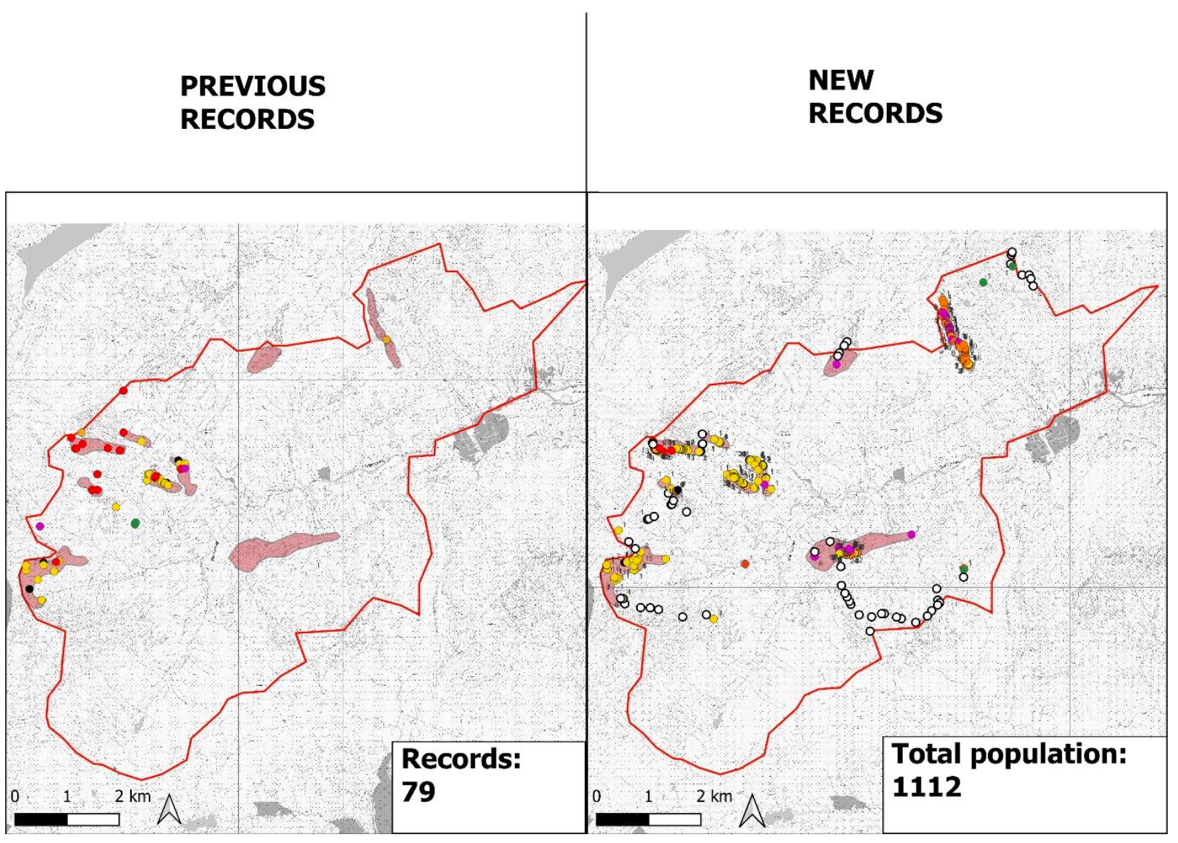
New records and locations of montane and sub-montane willows found in Glen Lochay after surveys across the estate in summer 2024.
The survey recorded four montane willow species – downy willow (Salix lapponum), mountain willow (Salix arbuscula), net-leaved willow (Salix reticulata) and whortle-leaved willow (Salix myrsinites) – and one sub-montane species – dark-leaved willow (Salix myrsinifolia). Several of these species are nationally scarce and some are considered vulnerable or endangered in the UK.
Among the most exciting discoveries were two populations considered nationally significant. At Creag nan Bodach, north-east of the estate, 255 individuals of downy willow were recorded, making it one of the best sites for the species in Scotland. Equally impressive was a population of 157 net-leaved willow in Coire Cheathaich North, north-west of the estate bordering the SSSI, which may be one of the largest populations of this species outside nearby Ben Lawers National Nature Reserve.
A downy willow bush on the South side of Glen Lochay. Before this survey no montane willows had been recorded in this area.
The Southside Crags also emerged as a conservation hotspot. Despite having no previous willow records, this area contained the estate’s largest population of mountain willow and dark-leaved willow, and its second-largest population of downy willow. The survey identified several populations here that may be large enough to remain viable in the long-term.
As part of the survey, one particularly encouraging finding was evidence of natural regeneration. At Creag nan Bodach, young downy willow plants were found growing away from the protective crags and onto surrounding slopes. Natural regeneration of montane willows is rare in Scotland [3] and suggests that some populations on the estate retain the ability to recover if conditions improve.
In spite of several positive findings from the survey, many montane willow populations remain small, isolated and vulnerable. Heavy grazing pressure from deer has historically prevented willows from spreading beyond inaccessible cliffs and ledges. Reducing deer pressure is the single most effective action for encouraging natural regeneration across the Glen Lochay. Current deer management is helping, but further reductions would be necessary to allow widespread recovery. Alternatively, targeted deer fencing could be used around key populations and help connect isolated populations, increase genetic diversity and restore larger areas of mountain woodland habitat [3].
Since the survey was carried out, activities have included collecting montane willow seeds and cuttings in 2025 and 2026. Some of this genetic material has been used by Forest & Landuse Scotland (FLS) for montane willow conservation work elsewhere. We have also been rearing montane willow species as a genetic resource at on on-site nursery. In the spring of 2026, montane willows (downy willow, woolly willow [Salix lanata] and whortle-leaved willow) reared by Trees for Life and Wild Strathfillan were planted by Ripa Gar on the lower slopes of Meall Glass and Sgiath Chùil, west of the estate, within deer fencing enclosures.
The survey shows that Glen Lochay already holds an extraordinary natural asset of montane willows. With the right management, its rare montane willow communities could expand significantly, benefiting biodiversity, strengthening Scotland’s mountain ecosystems and helping secure the future of some of the nation’s rarest plants.
Summary of key findings from the report:
Rare willow species recorded: 5
Previous willow records on the estate: 79
Individual willows recorded in 2024: 1,112
Estimated true population: up to 1,500
Nationally significant downy willow population at Creag nan Bodach: 255 plants
Nationally significant net-leaved willow population at Coire Cheathaich North: 157 plants
Main conservation priority: reduce deer browsing pressure and support regeneration
Project status
Start: 2024
Duration: 5 – 10+ years
Status: Project in progress
References
[1] Watts S.H. (2025) Montane willow scrub restoration in Scotland: reviewing 30 years of progress to reestablish the altitudinal treeline. Restoration Ecology, 33(1), p.e14290.
[2] NatureScot (2021) Ben Heasgarnich (SAC & SSSI). All SAC & SSSI habitat features. Beinn Heasgarnich Site Condition Monitoring Note 2021.
[3] Watts S.H., Griffith A., Mackinlay L. (2019) Grazing exclusion and vegetation change in an upland grassland with patches of tall herbs. Applied Vegetation Science, 22(3), 383-393.
Authors
Stuart Smith (The James Hutton Institute)
Julia Stewart and Innes Manders (Catkin Ecology)