

Ground preparation for tree planting and soil carbon impacts
Authors: Stuart Smith, Marlow Bushman, Thomas Parker (The James Hutton Institute)
Planting trees is an approach being adopted globally to combat climate change with the view that trees store carbon and will increase soil carbon storage. Before planting trees, forestry managers often prepare the ground by disturbing soil and vegetation to create preferential conditions for tree growth, such as removing competing vegetation or creating mounds to improve soil drainage [1]. While this helps young trees establish and survive, it may also disturb soils and lead to soil carbon loss [2]. This project aims to understand how significant the carbon costs of soil disturbance are and how they compare with the carbon gains from growing trees.
What are the types of ground preparation for trees at Glen Lochay?
Types of ground preparation vary in extent of disturbance, with mounding being the main type of ground preparation used for tree planting in the UK uplands. In Glen Lochay two types of mounding have been used: (1) hinge mounding, and (2) inverted mounding. There has also been some areas where trees have been slot planted into vegetation with minimal disturbance.
Hinge mounding is where an excavator lifts and turns over soil, inverting and depositing the soil on the soil surface and creating a mound and an adjacent hole. Inverted mounding, is where an excavator lifts and turns over a section of soil, but the inverted soil is placed back into the hole (with the underlying soil now on top to plant a tree seedling into). Mounding removes competing vegetation and improves soil drainage; however, those same conditions can accelerate soil erosion and the decomposition and breakdown of the soil carbon.
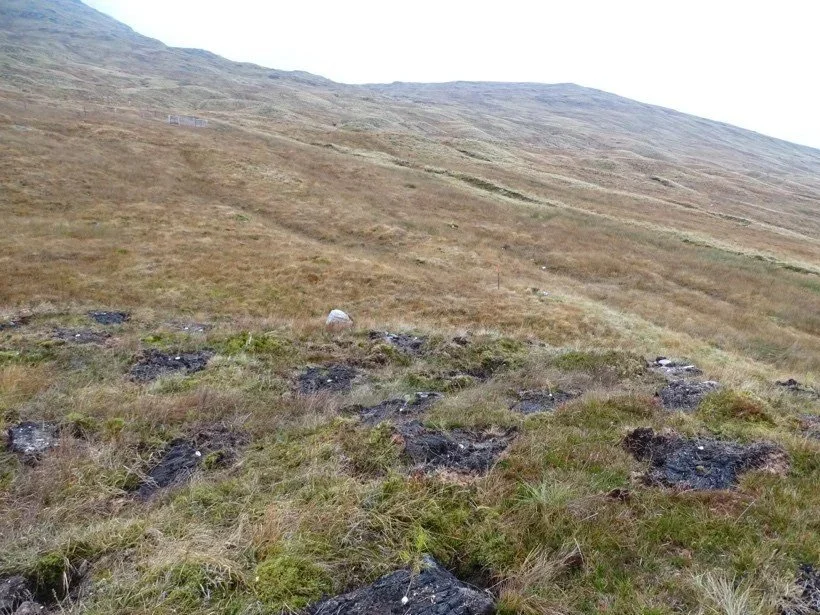
An area of inverted mounding planted with tree seedlings in Glen Lochay. The inverted soil has been reinserted in the excavated hole in November 2024.
How have we been studying the carbon impacts of mounding?
To understand the impacts of mounding, we have been surveying a time sequence of tree planting at Glen Lochay. We have been surveying planted areas at approximately 1, 5 and 10 years since planting to understand how soil disturbance changes through time.
Fieldwork involves several strands:
Measuring the shape and volume of mounds and holes using a custom-built pin-frame survey system to calculate net change in volume.
Collecting soil samples to determine carbon content and soil density.
Burying litterbags filled with plant material to measure decomposition rates in the mound, hole and undisturbed vegetated ground and relating this to soil temperature and moisture monitored using sensors.
Monitoring soil erosion losses using buried erosion pins in mounds and undisturbed vegetation.
Assessing tree growth and survival of trees to determine carbon gains from woodland creation.
Together, these measurements will allow us to see how much soil and carbon may have been lost following ground preparation, and by which route – whether decomposition or erosion – and whether carbon in the trees can compensate for these losses over time.
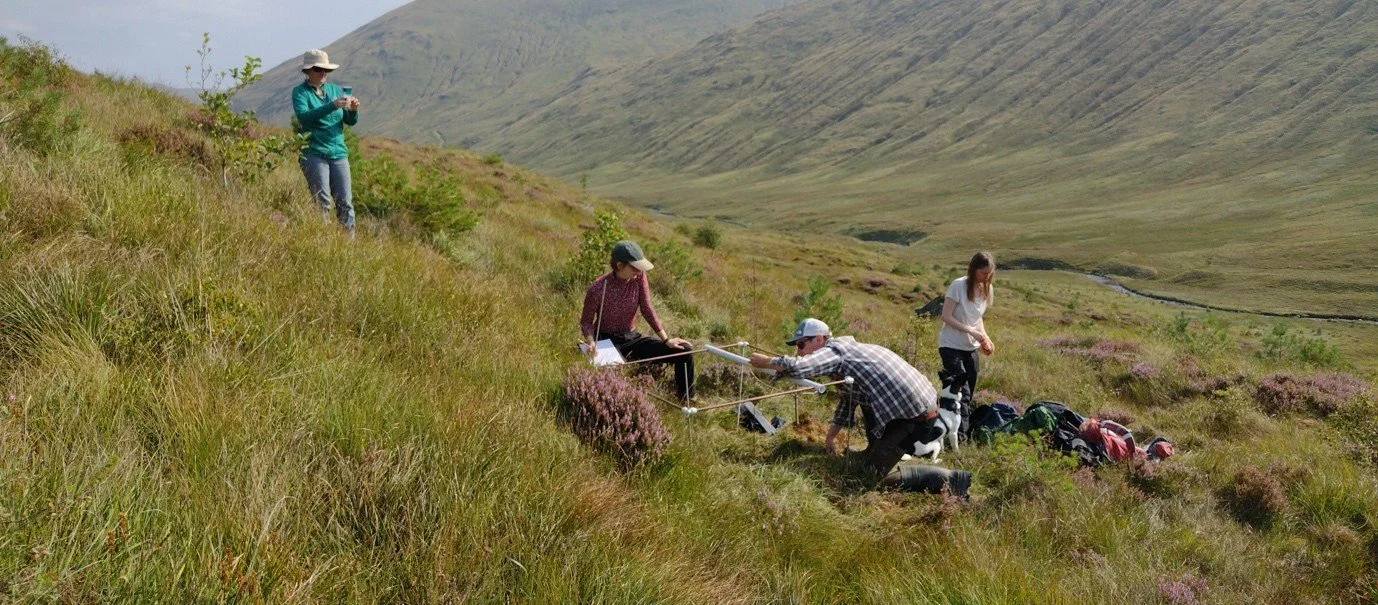
James Hutton Institute staff and volunteers from Scottish Environment Protection Agency SEPA) doing a pin-frame survey of a tree planting mound in August 2025.
3D image of a tree planting mound and hole generated by pin frame measurements dropping pins every 10 cm and calibrating this to the ground surface level.
What have we found so far?
Although the project is still ongoing, some interesting patterns are already emerging.
The most striking result is that within 5 years mounds contain substantially less soil than the holes they were created from. Surveys of 40 mound-hole pairs showed that, on average, mounds had lost around one-third of their original volume, equivalent to approximately 0.02 cubic metres of soil per mound.
Preliminary results from soil sensors show mounds experience larger fluctuations in moisture and temperature than undisturbed vegetation and holes, which likely influence soil carbon losses. Mounds repeatedly dry and re-wet, conditions known to encourage the breakdown and release of soil carbon. In contrast, many holes and vegetated undisturbed ground remain consistently wet with many holes waterlogged, which can slow decomposition and thus retaining carbon in the soil. The first year of litterbags were collected in the summer 2026 so we will see whether the soil environmental conditions of mounds have accelerated decomposition rates.
Why does this study matter?
Scotland's upland soils are nationally major carbon stores. If preparing land for tree planting causes substantial losses of soil carbon, some of the climate benefits associated with new woodland could be reduced, at least in the short to medium term (decadal timescale). The UK Woodland Carbon Code suggests using ground preparations that cause minimal soil disturbance to protect existing soil carbon, and avoid planting in peaty soils. This advice is to maximise verified carbon yield. Yet, practices of mounding are widely used with a lack of research on the balance of soil carbon disturbance and net gain from tree planning.
The Glen Lochay study is one of the most detailed investigations on upland carbon-rich soils of mechanical site preparation currently underway in the UK. By combining measurements of soil disturbance, carbon storage, decomposition, microclimate and tree growth, it aims to provide evidence that can guide future woodland planting on carbon-rich soils.
Project status
Start: 2025
Duration: 3 – 5 years
Status: Project in progress
References
[1] Häggström, B. et al. 2024. Effects of planting position, seedling size, and organic nitrogen fertilization on the establishment of Scots pine (Pinus sylvestris L.) and Norway spruce (Picea abies (L.) Karst) seedlings. Forests, 15(4), 703.
[2] Vanguelova E (2019) Ground preparation impacts on soil carbon- scenarios. Forest Research report. pp1-9.