

How can fungal pellets improve woodland restoration in Glen Lochay?
Authors: Stuart Smith, Marlow Bushman, Andy Taylor (The James Hutton Institute)
When we think about restoring woodlands, we usually focus on trees. But some of the most important parts of a forest are hidden underground. Most tree species rely on partnerships, or symbiosis, with microscopic soil fungi called mycorrhizal fungi. Mycorrhizal fungi colonise tree roots and help trees access water and nutrients from the soil. In return, the tree supplies the fungi with sugars produced through photosynthesis. This symbiosis is essential for the trees to survive and grow.
Many UK tree species rely on a group mycorrhizal fungi called ectomycorrhizal fungi. However, in grasslands and heathlands there are different types of fungi, unless trees have been in the landscape [1]. When planting trees in upland grasslands and heathlands trees do not have the necessary fungal species to survive and this is thought to contribute substantially to poor survival and growth of planted trees [2]. As woodland creation expands across upland habitats, researchers are trying to find ways to support these underground fungal networks to improve the success of newly planted trees.
What research is taking place in Glen Lochay?
We have established long-term trials investigating whether adding pellets with mycorrhizal fungi to the soil when planting trees can improve woodland establishment.
The project began in 2024 with the planting of more than 2,500 native tree seedlings, including Scots pine, birch, alder and willow. Every seedling has been mapped using GPS, allowing us to monitor survival and growth over many years. All tree planting trials occur within deer fenced areas to prevent seedlings being browsed.
As part of the trial, we have planted seedlings with fungal pellets, supplied by Rhizocore. These pellets contain mycorrhizal fungi known to form a symbiotic partnership with planted tree species we used. Some seedlings were planted as a control with fertiliser and without fungi (as per common forestry practices), others received no fertiliser or fungi, whilst the other treatments were planted with fungal pellets either with or without fertiliser.
The trial also has different planting times in the spring versus the autumn. Foresters usually prefer to plant trees in autumn because the soil is warm when planting and rainfall is guaranteed in the coming months as opposed to spring planting which risks dry conditions and high mortality. However, spring planting may be more beneficial for establishing new fungal symbiosis as the trees photosynthesis and supply sugars to the fungi.
Our trials are part of a broader effort to understand not only how trees grow above ground, but also how woodland restoration influences soil biodiversity. At the onset of the trial we sampled the soil from pre-planted areas and nursery seedling roots using DNA sequencing techniques to identify all fungal species present before we started tree planting.
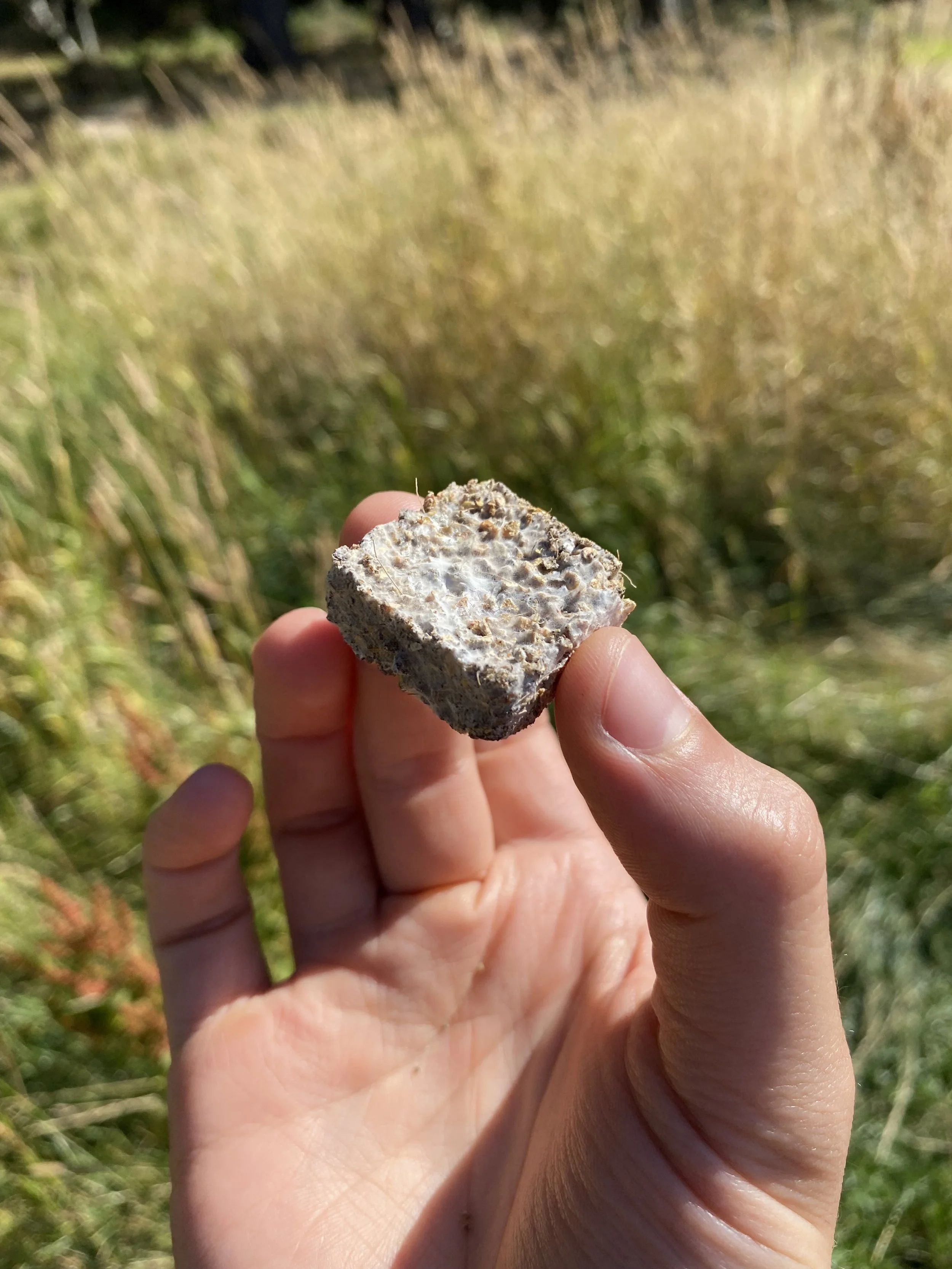
Rhizocore fungal pellet. Pellets contain mycorrhizal fungal species that are buried next to tree seedling roots on planting.
What have we found so far?
As the first seedlings were planted in 2024, the project is currently still in its early stages. Initial seedling survival after one year was high, with 99% survival from spring planting and 88% survival in autumn, the latter being lower due enduring winter conditions and subsequent warm and very dry spring.
So far, we have not found clear evidence that fungal pellet treatments increase survival. In a nursery experiment at Glen Lochay, we manipulated the dosage of pellets seedlings received and those receiving the highest fungal pellet dose grew slightly slower than untreated seedlings in the first year.
Further work is planned with harvesting of seedlings in 2026 to determine whether intended fungal species found in the pellets have associated with planted tree seedlings. Seedlings are currently monitored annually with the expectation that treatment effects on survival and growth may not be observable for a few more years.
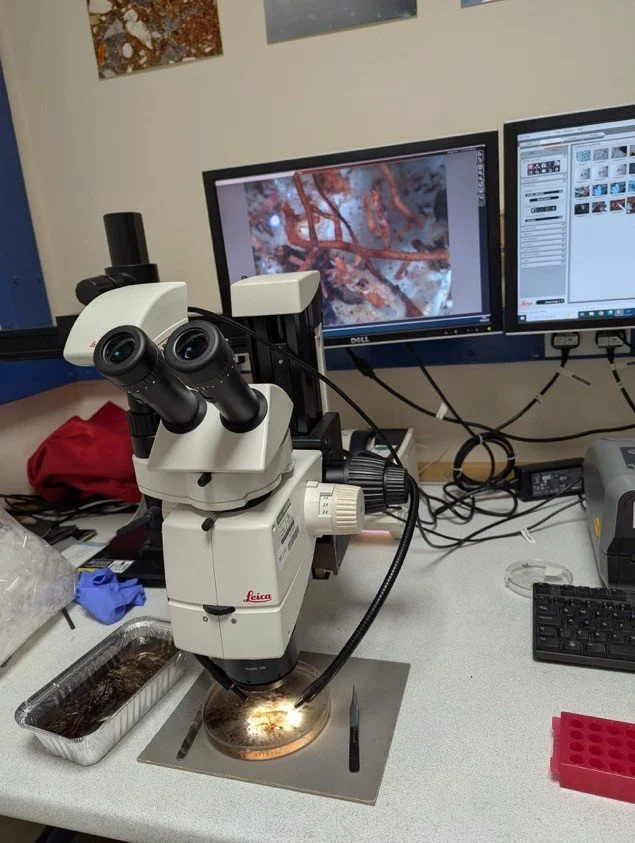
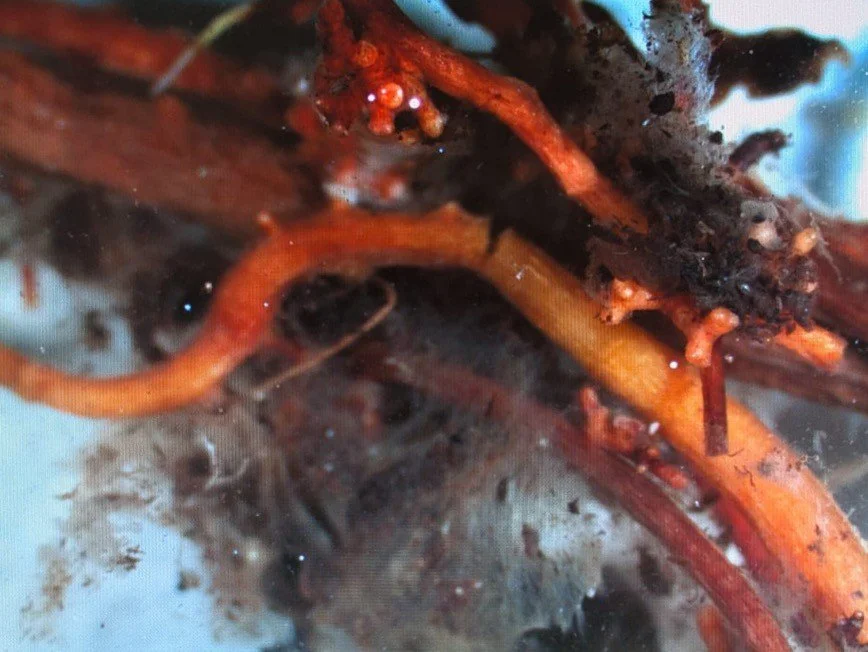
Investigating ectomycorrhizal fungal morphotypes under on Scots pine roots under the microscope to take samples for DNA sequencing.
Why does this study matter?
The UK, and many countries globally, have ambitious tree planting targets to meet net-zero commitments and restore forest cover. However, tree planting projects can experience high mortality rates due to several pressures including drought, herbivory and a lack of appropriate mycorrhizal fungi. Ultimately, this research is trying to understand whether planting trees with mycorrhizal fungal species can improve tree planting efforts. While young woodlands are transforming the landscape of Glen Lochay, the project seeks to understand whether successful forest restoration may depend just as much on the hidden world beneath our feet.
Project status
Start: 2024
Duration: 5 – 10+ years
Status: Project in progress
References
[1] Martius, L.R. et al. (2025) Nucleation in temperate woodland regeneration: dual mycorrhizal Salix facilitate ectomycorrhizal tree establishment. Oikos, 2025(4), e10974.
[2] Baird A. & Pope F. (2022) ‘Can't see the forest for the trees’: The importance of fungi in the context of UK tree planting. Food and Energy Security, 11(4), p.e371.